The integrated watch: how a steel octagon spawned half a century of imitations
In 1972 Audemars Piguet charged over 3,000 francs for a steel watch with no visible lugs. It sounded absurd. Four years later half of Switzerland was copying it, and today there is one for under €1,000 that sells twenty times its forecast.
Machine translation pending human review. Figures and sources match the original.
An integrated watch is one whose case and bracelet are conceived as a single piece: the bracelet grows from the case, without the conventional lugs that let you swap in any strap. It is a design decision with a commercial consequence. The bracelet stops being an accessory.
The idea was not born in 1972. Rolex had tried an integrated riveted bracelet on its Precision ref. 9083 in the 1950s, and the list of precursors has room for other experiments. But nobody had built a luxury product on it.
The commission
Audemars Piguet wanted a steel sports watch and the drawing came from Gérald Genta. On when and how quickly there are versions we have not been able to reconcile, including Genta's own. What is not disputed is the result: the Royal Oak 5402, with an octagonal bezel, eight white gold screws and a tapisserie dial, which appeared at the 1972 Basel fair. The brand's official chronicle gives 39 mm and about 7.15 mm total thickness, with calibre 2121, then the world's thinnest automatic with date.
The price is not unanimous: Revolution says 3,300 francs and other sources up to 3,750. And the brand itself gives the measure of the risk: the first 1,000 watches took less than two years to place. Today it is the piece the house rests on: about 88% of its sales are Royal Oaks, according to a report on the Morgan Stanley study.
The seventies avalanche
The list of dates speaks for itself. In 1973, Tudor launched its 38 mm Prince Oysterdate. In 1975, Girard-Perregaux presented the Quartz Chronometer, which the Italians renamed Laureato and which has an often forgotten detail: it was quartz. In 1976, Genta did it again for Patek Philippe with the Nautilus ref. 3700, 42 mm and 120 metres, and for IWC with the 40 mm Ingenieur 1832, of which about 1,000 are believed to exist. In 1977, Vacheron Constantin presented the 37 mm 222, the work of Jörg Hysek and often mistakenly credited to Genta. Revolution counts about 700 of those Jumbos.
The size of the pioneers
Diameter in mm of the first luxury integrated watches and launch year. The Nautilus measures 42 mm counting the side "ears"; its bezel is about 40. Royal Oak: official AP chronicle. Laureato: largest of its initial sizes (26, 30 and 35 mm), according to Luxury Bazaar, a retailer, unconfirmed by Girard-Perregaux. 222: 37 mm according to Watchonista; Revolution gives 38 mm. Rest: Revolution.
View data as table
| Series | X axis | Value |
|---|---|---|
| Diameter (mm) | Royal Oak, 1972 | 39 |
| Diameter (mm) | Tudor Prince Oysterdate, 1973 | 38 |
| Diameter (mm) | Laureato, 1975 | 35 |
| Diameter (mm) | Nautilus, 1976 | 42 |
| Diameter (mm) | Ingenieur 1832, 1976 | 40 |
| Diameter (mm) | Vacheron 222, 1977 | 37 |
Source: revolutionwatch.com
What seems a normal size today was huge then: AP itself places its first series watch in the oversized category, hence the nickname "Jumbo". Production figures do not tell a story of instant success either: about 1,000 Ingenieurs, about 700 222 Jumbos, and a 222 withdrawn in the mid-1980s.
From cult to business
Then came a quieter second wave, with the 1978 Santos, the 1979 Polo and Chopard's St. Moritz, with 1,000 orders at Basel in 1980. The idea survived the 1980s and 1990s without fuss, until the Nautilus 5711 and the Royal Oak turned it into a financial obsession.
In July 2021 Revolution put a green-dial 5711 at under $35,000 in store and over $300,000 on resale. The 2026 Hilco report places the discontinued 5711 between $113,600 and $147,700.
The integrated watch for everyone
The most interesting turn did not come from Geneva. Tissot had a 35 mm PRX from 1978, which had been born under another name. It revised it at 40 mm after a decision taken in 2020 and the move came out, according to the CEO, twenty times above forecast. Today the PRX Powermatic 80 costs $850 on Tissot's site, while a 38 mm Royal Oak chronograph runs to €39,200. There is also an awkward detail: Morgan Stanley estimates that Tissot's turnover fell almost 25% between 2020 and 2024, a figure Swatch Group rejects. A hit model does not always save a brand.
The rest of the market followed: Alpine Eagle and BR 05 in 2019; the 41 mm Tudor Royal and 42 mm Streamliner in 2020; and IWC gave the Ingenieur back its bracelet in 2023, at 40 mm and 12,000 francs. Of the ten watches Chrono24 lists as most bought in the US in 2025, three are integrated: Vacheron Overseas, IWC Ingenieur and Laureato.
Now they are shrinking too
The integrated watch is following the size trend as well. The 2026 anniversaries make that clear.
Integrated watches: from launch size to the smallest today
Diameter in mm. Nautilus: 1976 3700 (Revolution) against 2026 5610/1P (SJX). Streamliner: 2020 (Revolution) against 2026 (Luxury Bazaar). Laureato: current 42 mm against the 2025 Laureato Fifty, 39 mm (press extract). Octo Finissimo: Luxury Bazaar.
- Starting reference
- New reference
View data as table
| Series | X axis | Value |
|---|---|---|
| Starting reference | Patek Nautilus | 42 |
| Starting reference | Moser Streamliner | 42 |
| Starting reference | Girard-Perregaux Laureato | 42 |
| Starting reference | Bulgari Octo Finissimo | 40 |
| New reference | Patek Nautilus | 38 |
| New reference | Moser Streamliner | 34 |
| New reference | Girard-Perregaux Laureato | 39 |
| New reference | Bulgari Octo Finissimo | 37 |
Source: luxurybazaar.com
Editorial opinion: the integrated watch is probably the only great horological invention of the last sixty years with nothing to do with mechanics. It is just geometry and a change of attitude: luxury could be steel and worn every day. The tragedy, and the merit, is that the design proved so strong that anyone with a competent workshop can evoke it. That is why a 1972 silhouette sells today from $850 to tens of thousands of euros, and why the difference is now almost never in the shape.
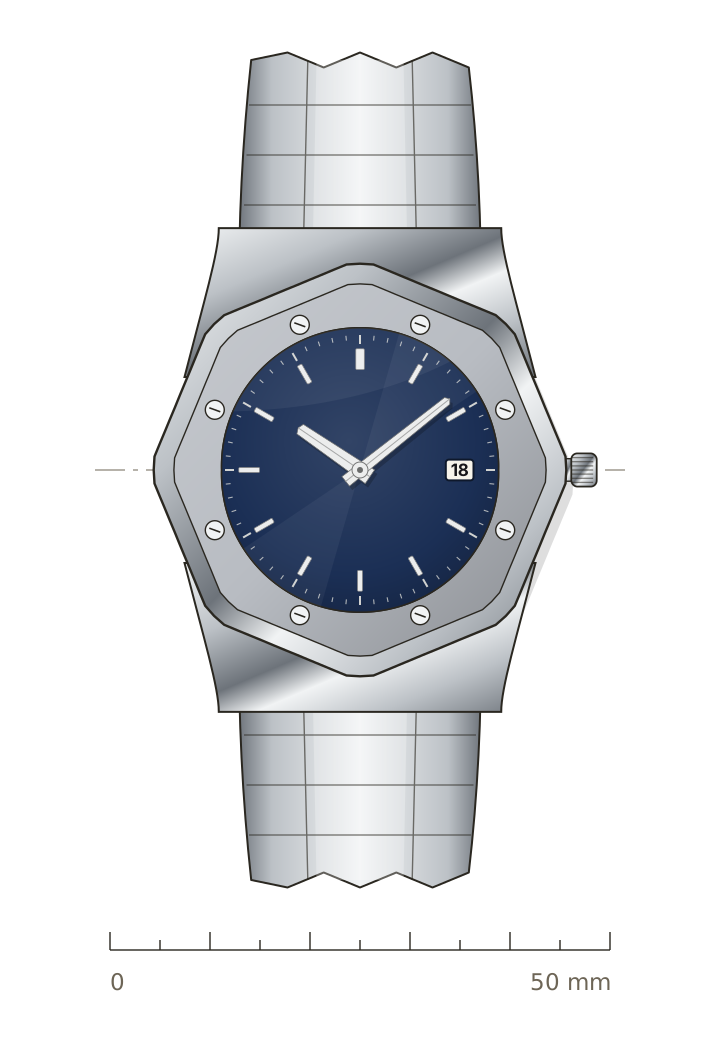 Royal OakAudemars Piguet
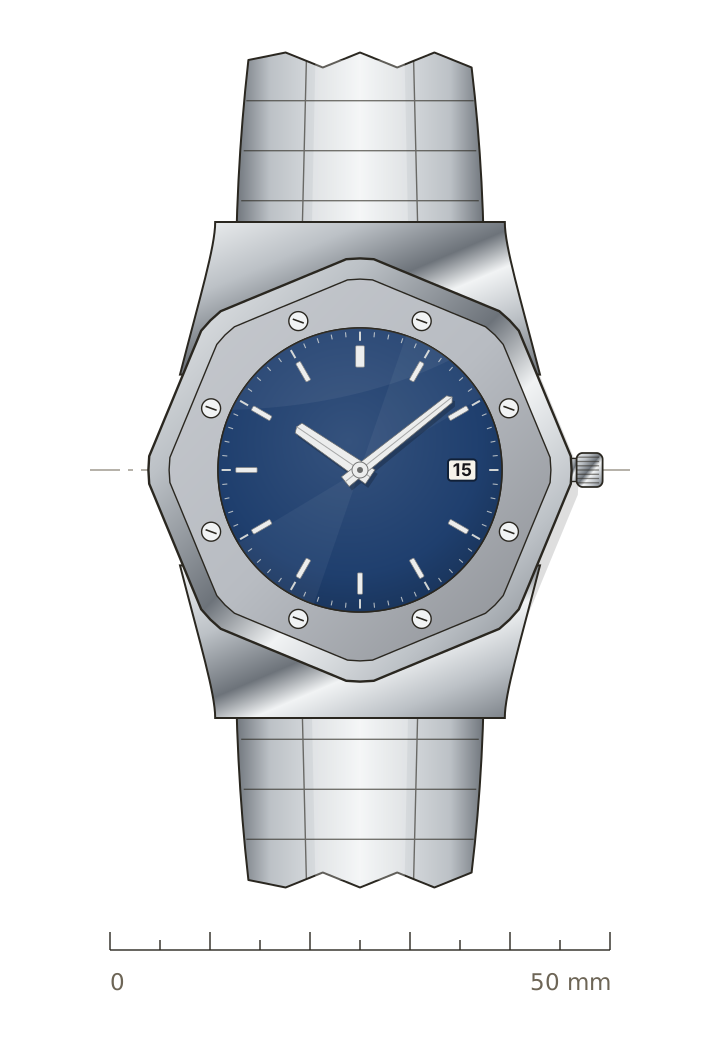 NautilusPatek Philippe
 Ingenieur Automatic 40 50 aniversarioIWC Schaffhausen
 Overseas Self-WindingVacheron Constantin
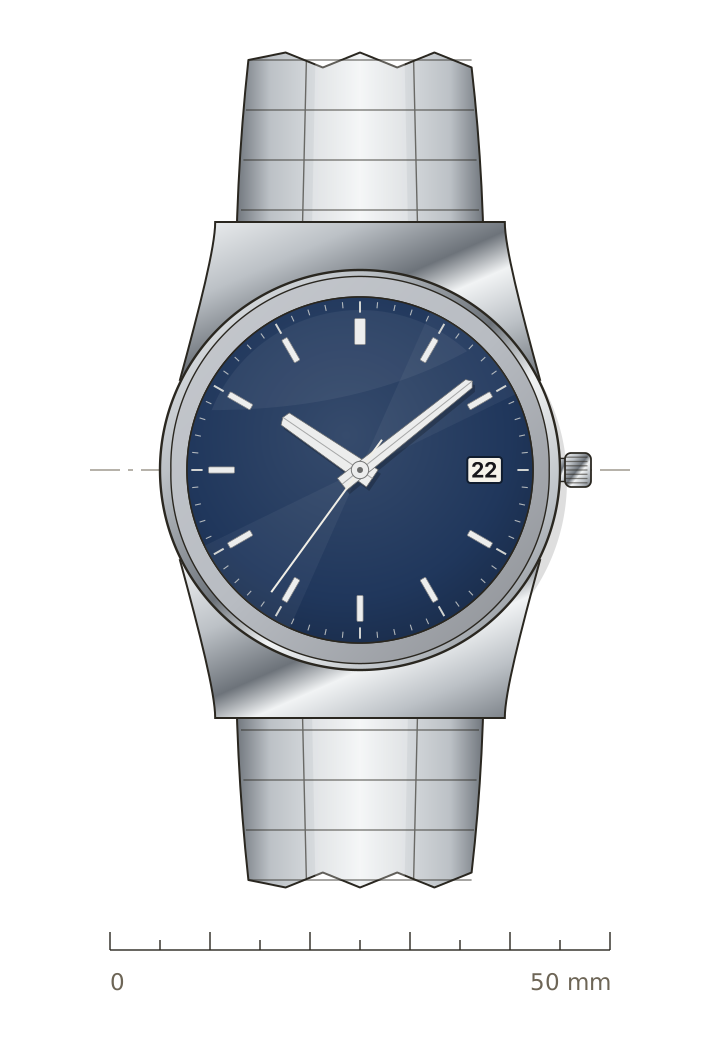 PRX Powermatic 80Tissot
Sources
- We're All One: The Integrated Bracelet Sports Watch Story (Revolution) revolutionwatch.com
- The Royal Oak Jumbo models (AP Chronicles, Audemars Piguet) apchronicles.audemarspiguet.com
- Laureato 42 mm (Girard-Perregaux) girard-perregaux.com
- A Quick Guide to the Girard-Perregaux Laureato (Luxury Bazaar) luxurybazaar.com
- Return of the Genta: IWC Ingenieur (Watchonista) watchonista.com
- Steel of Approval: Vacheron Constantin Historiques 222 (Watchonista) watchonista.com
- The Tissot PRX history (Oracle of Time) oracleoftime.com
- Interview Sylvain Dolla, Tissot (Monochrome) monochrome-watches.com
- Tissot PRX Powermatic 80 (official record, via our Archive) tissotwatches.com
- Royal Oak 38 mm chronograph (Fratello) fratellowatches.com
- Quand les banques tentent de percer le secret horloger (Le Temps, extract only) letemps.ch
- Swiss Watcher 2025 (Businessonline) businessonline.it
- Collateral in Question (Hilco Global) hilcoglobal.com
- Chrono24: US best sellers 2025 (Hypebeast, sponsored) hypebeast.com
- Patek Philippe's 50 Years of Nautilus (SJX) watchesbysjx.com
- 2026 Watch Trends: Downsized Watches (Luxury Bazaar) luxurybazaar.com