Rolex against Audemars Piguet: the million-watch icon and the fifty-thousand-watch icon
Rolex makes twenty-two watches for every Audemars Piguet and still does not win twenty-two to one in money. They are two opposite ways of building a myth: one spreads it across the range over a century, the other bets it almost entirely on a single octagonal case.
Machine translation pending human review. Figures and sources match the original.
Neither publishes its accounts. Everything below on sales is estimates by Morgan Stanley and LuxeConsult, not brand data, and contested at that: Swatch Group maintains that the figures for its brands deviate by 24% on average from the real ones. They serve for the order of magnitude, not the decimal.
Sizes that are nothing alike
In the 2025 estimate, Rolex turns over about 11 billion francs and sells around 1.15 million watches; Audemars Piguet, 2.6 billion and 53,000. AP rose 9% and overtook Patek Philippe and Omega for third place, behind Cartier. Rolex grew 4% and holds 32.9% of the market.
Estimated turnover of the largest Swiss brands, 2025
Billions of Swiss francs. Estimate by Morgan Stanley and LuxeConsult (February 2026), not brand figures, reported by Il Sole 24 Ore. Rolex's is described as wholesale in other reports; the channel split for the rest is not stated.
View data as table
| Series | X axis | Value |
|---|---|---|
| Estimated turnover (CHF bn) | Rolex | 11 |
| Estimated turnover (CHF bn) | Cartier | 3.5 |
| Estimated turnover (CHF bn) | Audemars Piguet | 2.6 |
| Estimated turnover (CHF bn) | Patek Philippe | 2.5 |
| Estimated turnover (CHF bn) | Omega | 2.2 |
| Estimated turnover (CHF bn) | Richard Mille | 1.75 |
Source: en.ilsole24ore.com
Estimated units, 2025
Watches sold according to the same estimate, which we have only found itemised in the Italian press (Il Sole 24 Ore and Businessonline). Treat as an order of magnitude.
View data as table
| Series | X axis | Value |
|---|---|---|
| Units | Rolex | 1150000 |
| Units | Cartier | 695000 |
| Units | Omega | 460000 |
| Units | Patek Philippe | 72000 |
| Units | Audemars Piguet | 53000 |
| Units | Richard Mille | 5960 |
Source: en.ilsole24ore.com
Rolex: a century of repetition
Rolex's formula is a system, not a watch. The brand was born in 1905 and celebrates a hundred years of its Oyster case in 2026, the piece much of its current catalogue rests on. Its names are refined rather than replaced, and the split shows it: on Chrono24, the Datejust brings in about 28% of its sold value, the GMT-Master II 14%, the Submariner and Daytona 12% each and the Day-Date 6%. No collection reaches a third. That dispersion is its insurance.
Rolex does not live on desire alone either. Its greatest strength lies at a specific price: 61.4% of what sold between $10,000 and $20,000 on Chrono24, the band where used steel Submariners, GMT-Master IIs and Daytonas fall.
Audemars Piguet: one card, played to the hilt
Founded in 1875 in Le Brassus and still in the hands of the founding families, AP had spent almost a century as a haute horlogerie house when in 1972 it presented a steel watch at 3,300 francs, a figure other sources raise to about 3,750. The Royal Oak, the work of Gérald Genta, became its reason for being. According to a report on the Morgan Stanley study, it accounts for 88% of its sales, and another extract attributing the estimate to HSBC puts it near 90%. We have not seen the figure in the original report, but the order is consistent: nothing like it exists among the big brands.
That concentration is expensive and cheap at once. It allows instant identity, scarce production and very high income per watch. It also ties the whole business to a single silhouette and a single fashion cycle.
What the used market says
Chrono24 lets us compare both on the same court, with the caveat that it is one platform. Rolex owns the middle band. AP only truly appears above $20,000.
Rolex and AP in the money moving on Chrono24
Share of value sold in %. Total: Q2 2026. By band: 2026 through Q2. Chrono24 data about its own platform. The bands are euro ranges converted to approximate dollars. Elsewhere in the report Chrono24 gives 61.4% and 38.6% for Rolex.
- Rolex
- Audemars Piguet
View data as table
| Series | X axis | Value |
|---|---|---|
| Rolex | Total | 30.5 |
| Rolex | USD 10,000-20,000 | 61.5 |
| Rolex | Over USD 20,000 | 38.5 |
| Audemars Piguet | Total | 4.2 |
| Audemars Piguet | USD 10,000-20,000 | 3.2 |
| Audemars Piguet | Over USD 20,000 | 13.8 |
Source: theideafarm.com
Both have lost ground at the top since 2023, though not equally: Rolex gives up 5.8 points and AP 1.2 above $20,000, while Patek Philippe gains 3.5. Between $10,000 and $20,000, by contrast, AP gains 1.3 points and Rolex loses 8.4. There is a changing of the guard, and at the top Patek Philippe leads it.
On prices, the quarter also separates them: ChronoPulse gave +2% for AP and -0.2% for Rolex in Q3 2026. One quarter proves nothing, and over twelve months Chrono24 publishes +6% for Rolex, while we have not found the equivalent figure for AP.
Two ideas of scarcity
Editorial opinion: Rolex makes a lot and makes it seem like little. AP makes little and makes it seem impossible. The first demands an industrial machine and decades of discipline; the second, a single masterpiece and the courage not to dilute it. Rolex's method withstands a bad five years better. AP's takes more for each watch, as long as the Royal Oak stays the Royal Oak. And that is the question no table answers.
 SubmarinerRolex
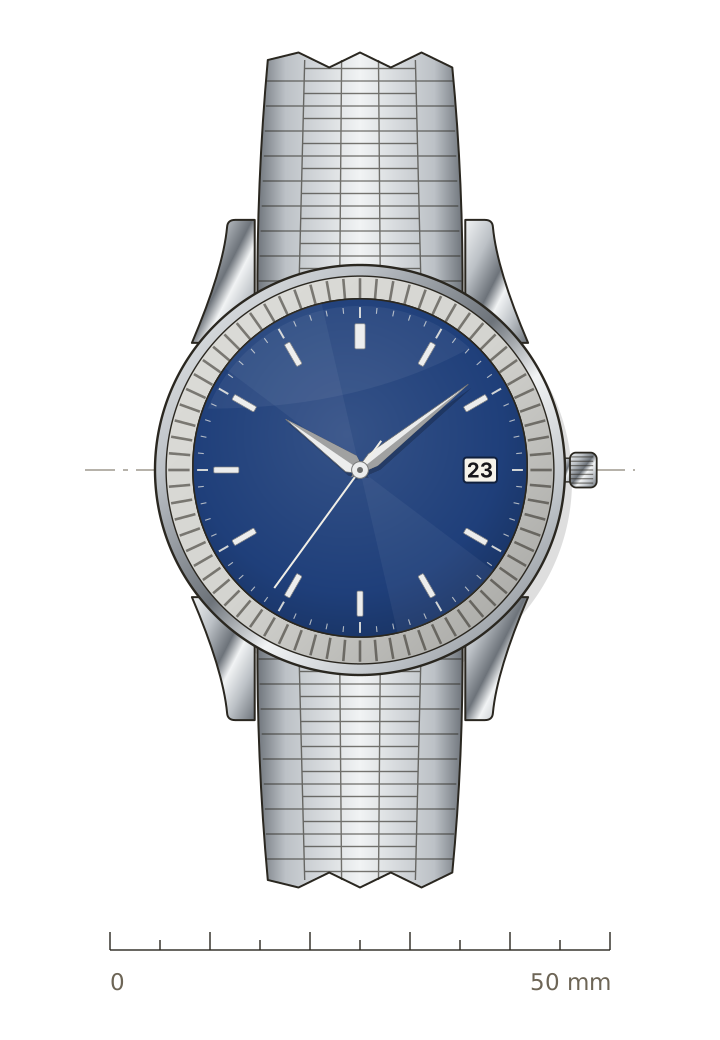 Datejust 41Rolex
 Royal Oak AutomáticoAudemars Piguet
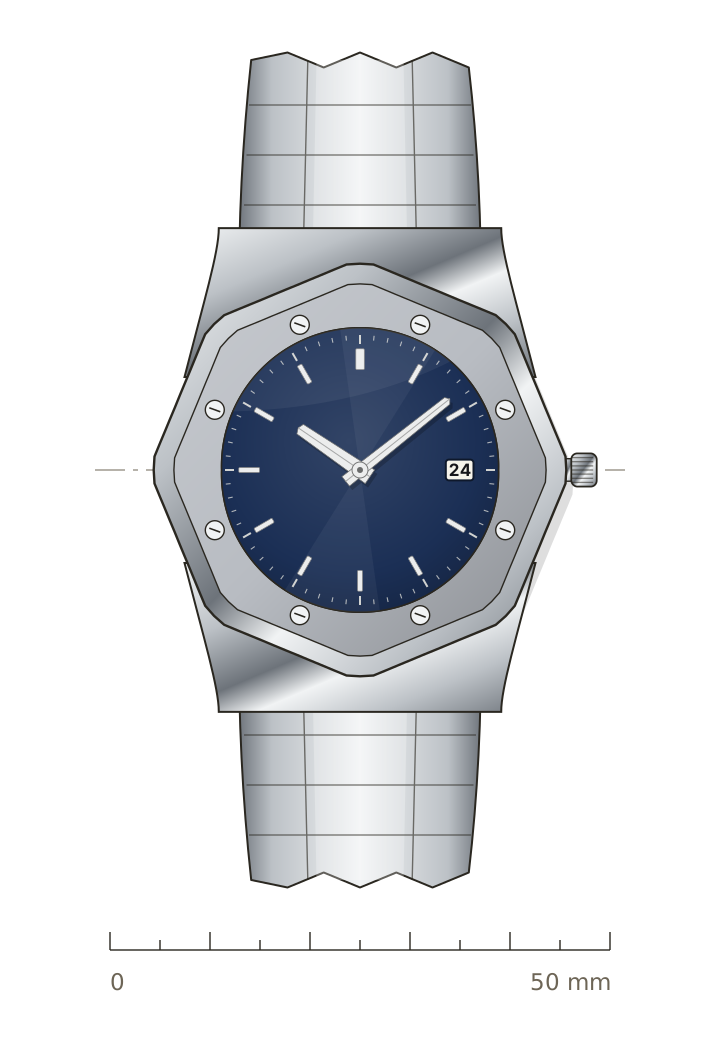 Royal Oak Jumbo ExtraplanoAudemars Piguet
Sources
- Rolex, Cartier and Audemars Piguet on the podium (Il Sole 24 Ore) en.ilsole24ore.com
- Swiss Watcher 2025 (Businessonline) businessonline.it
- Morgan Stanley report reveals the top 50 (WAQT) waqt.com
- The Rolex Report 2026 (Chrono24) theideafarm.com
- Chrono24 ChronoPulse Q3 2026 (Esquire India) esquireindia.co.in
- The integrated bracelet sports watch story (Revolution) revolutionwatch.com
- Audemars Piguet (Wikipedia) en.wikipedia.org
- Hands-on Oyster Perpetual 41 134303 (aBlogtoWatch) ablogtowatch.com